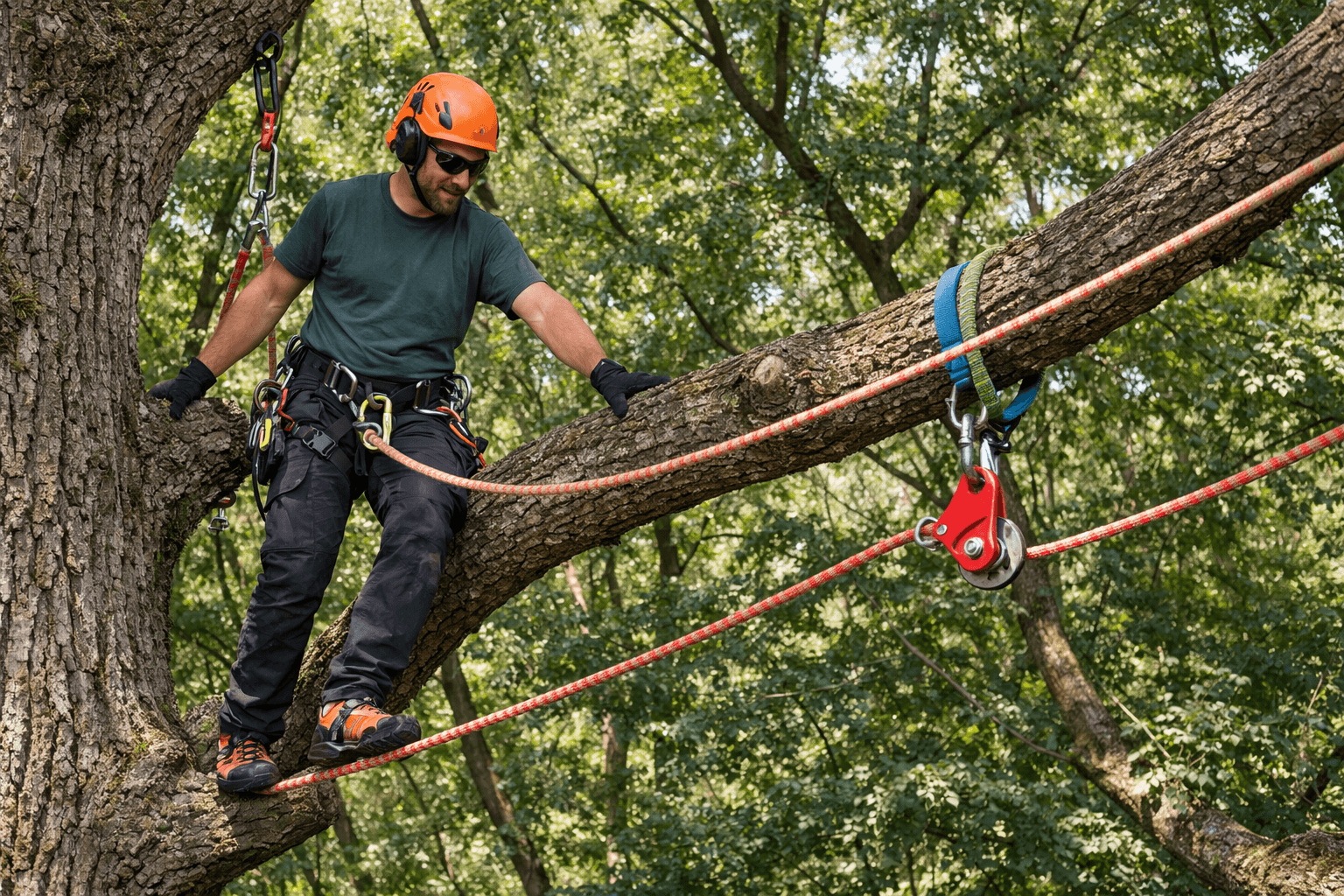
Mastering Redirects is the single most important skill I’ve developed over 15 years in the canopy. In my early days, I used to muscle my way through every lateral limb walk. I’d reach the tips, my rope would be at a shallow, dangerous angle, and I’d be sweating like a dog. Now? I don’t move an inch without calculating my rope angles. A redirect isn’t just a “trick”; it’s a life-saving manipulation of force that keeps you stable when you’re 80 feet in the air.
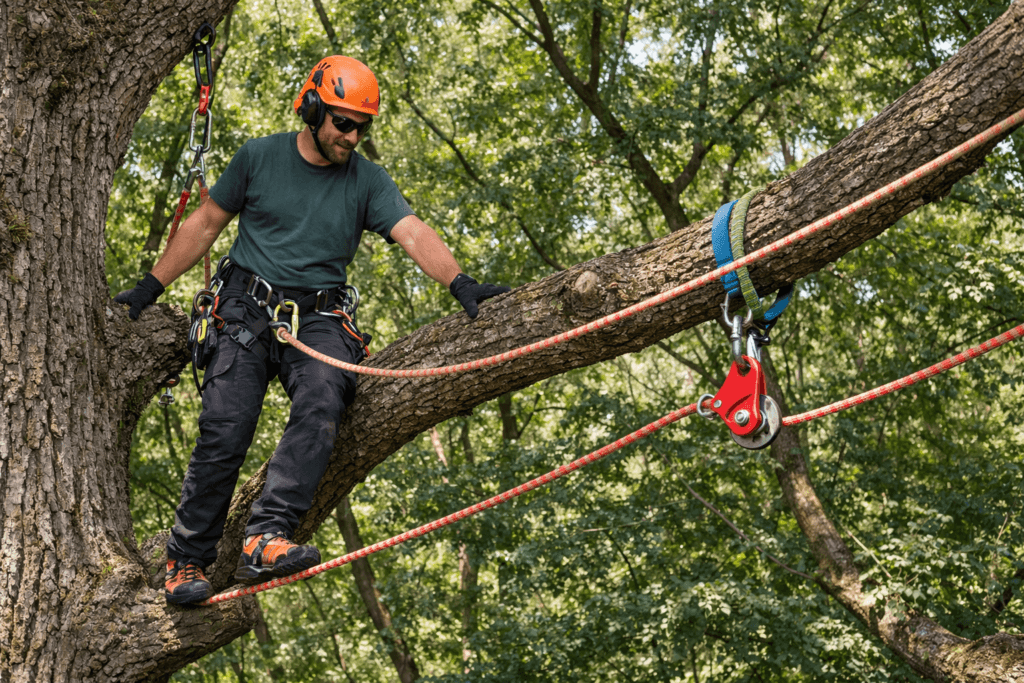
The Technical “Why” Behind Mastering Redirects
A redirect is any point where you divert your climbing line from its original tie-in point (TIP) to a secondary anchor.
- Lateral Stability: When you walk out on a long horizontal limb, your main TIP pulls you back toward the trunk. Mastering redirects allows you to change that pull, keeping your weight over your feet so you don’t pendulum-swing into a vertical stem if you slip.
- Energy Conservation: Fighting rope drag is a losing battle. A well-placed hardware redirect makes the rope move like butter, saving your arms for the actual cutting.
- Work Positioning: You can’t perform a precision cut if you’re struggling to stay balanced. Redirects give you the “solid ground” feel in a world made of swaying branches.
OSHA, ISA, and Mastering Redirects Safely
We don’t just throw ropes for fun; we follow a code. In the U.S., OSHA 1910.266 and the ANSI Z133 safety standards are the bibles of our trade.
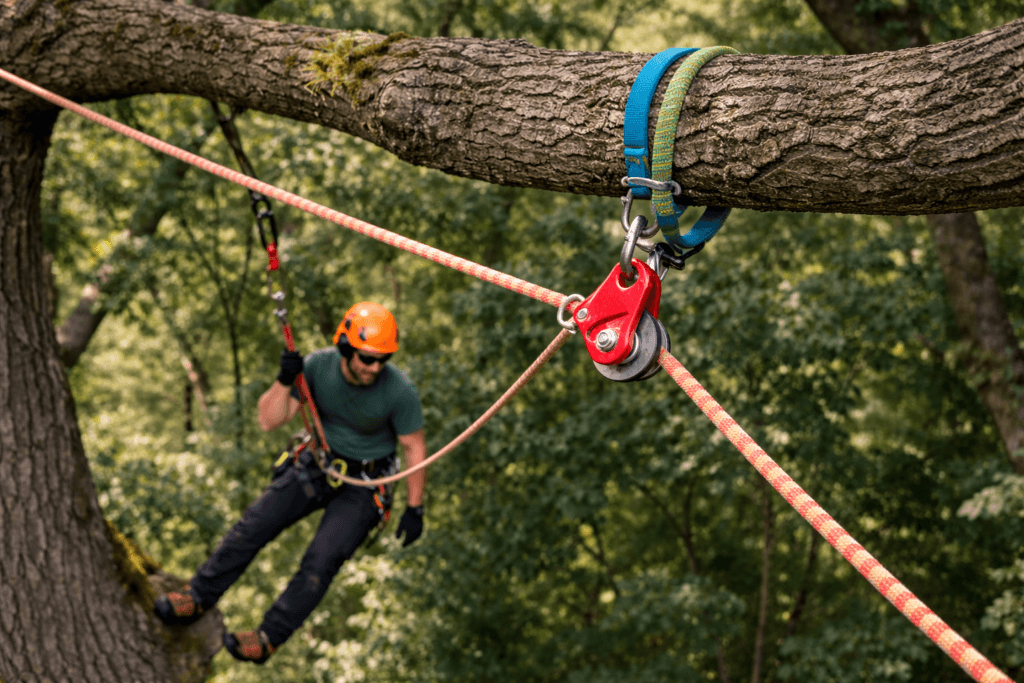
- The Two-Point Rule: OSHA is clear—if you’re running a saw, you better have two points of attachment. While mastering redirects, remember they count as part of your system, but don’t replace the need for a secondary lanyard during a cut.
- Anchor Strength: ISA protocols remind us that a redirect is an anchor. I’ve seen guys use a 2-inch “sucker” branch as a redirect. Don’t be that guy. If that limb fails, your geometry changes instantly.
Technical Mechanics: Rigging and Dismantling
Redirects aren’t just for climbing; they are the heart of advanced rigging and directional felling.
Directional Felling with Redirects
When you’re in a tight backyard and a tree has a heavy lean the wrong way, a redirect in a nearby “save” tree is your best friend.
- By running your pull line through a redirect, you can stand safely out of the “crush zone” while still applying maximum force to the notch.
- It allows you to change the direction of the pull without changing your position on the ground.
Complex Rigging and Dismantling
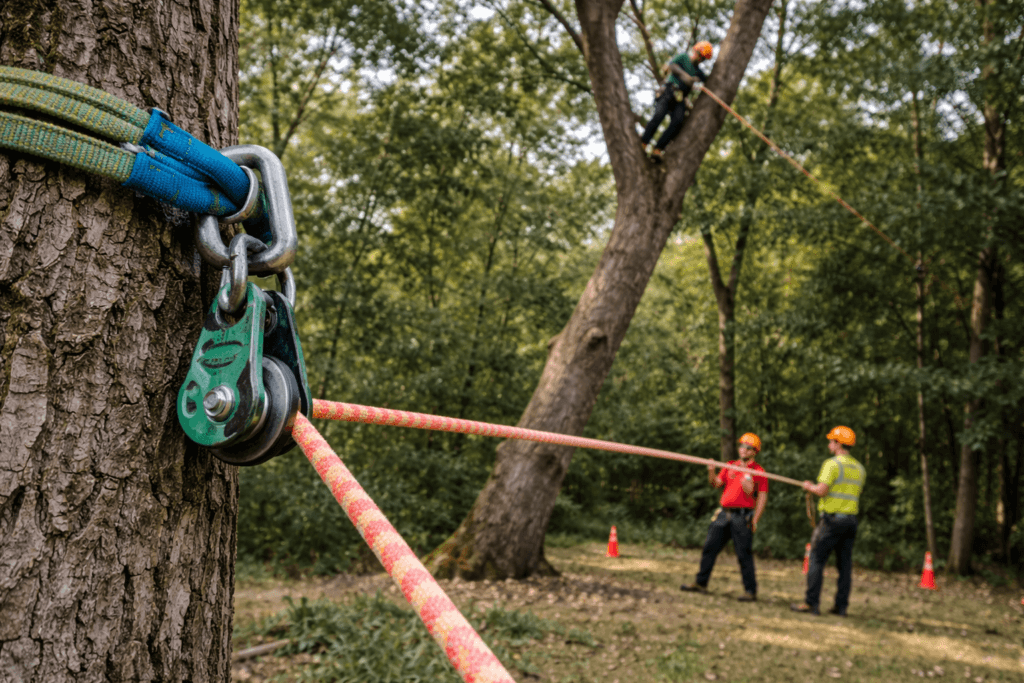
When we’re dismantling a massive canopy over a glass sunroom, we use redirects to manage “rope 180s.”
- Friction Management: By using a rigging block as a redirect, we can lead the load line away from the climber and toward the ground worker’s friction device (like a Port-A-Wrap).
- Load Distribution: A redirect allows us to spread the force of a falling log across multiple points in the tree, preventing a single anchor from snapping under dynamic load.
Natural vs. Hardware: My Professional Take
I spent years using natural crotches for redirects. They’re fast, but they’re “rope killers”.
- Natural Redirects: They create massive friction. In a DdRT (Doubled Rope) system, a natural redirect makes it twice as hard to climb. Plus, you’re burning the cambium of the tree. I only use these for quick, light lateral pops.
- Hardware Redirects: Pulleys and low-friction rings are the gold standard in 2026. They allow for “retrievable” setups. With a retrieval ball and a specialized sling, I can pop my redirect from the ground once I’m done. No more climbing back up just to get your gear.
The Physics of Failure: Vector Forces
If you take one thing from my 15 years of experience, let it be this: Understand the Angle.
- The 120-Degree Rule: If your rope enters and leaves a redirect at a 120-degree angle, that limb is feeling 100% of your weight.
- The 0-Degree Turn: If you loop the rope completely back on itself (a 180-degree turn), that redirect limb is feeling 200% of your weight. If you’re 200 lbs with gear, and you pull a sharp redirect on a weak limb, you’re putting 400 lbs of force on a branch that might only be rated for half that.
Final Thoughts from the Canopy
Mastering redirects is about respect—respect for the tree, respect for the gear, and respect for gravity. If you want to be a “Technical Guide” in this industry, stop thinking about just getting high in the tree. Think about how you’re going to stay stable once you get there.