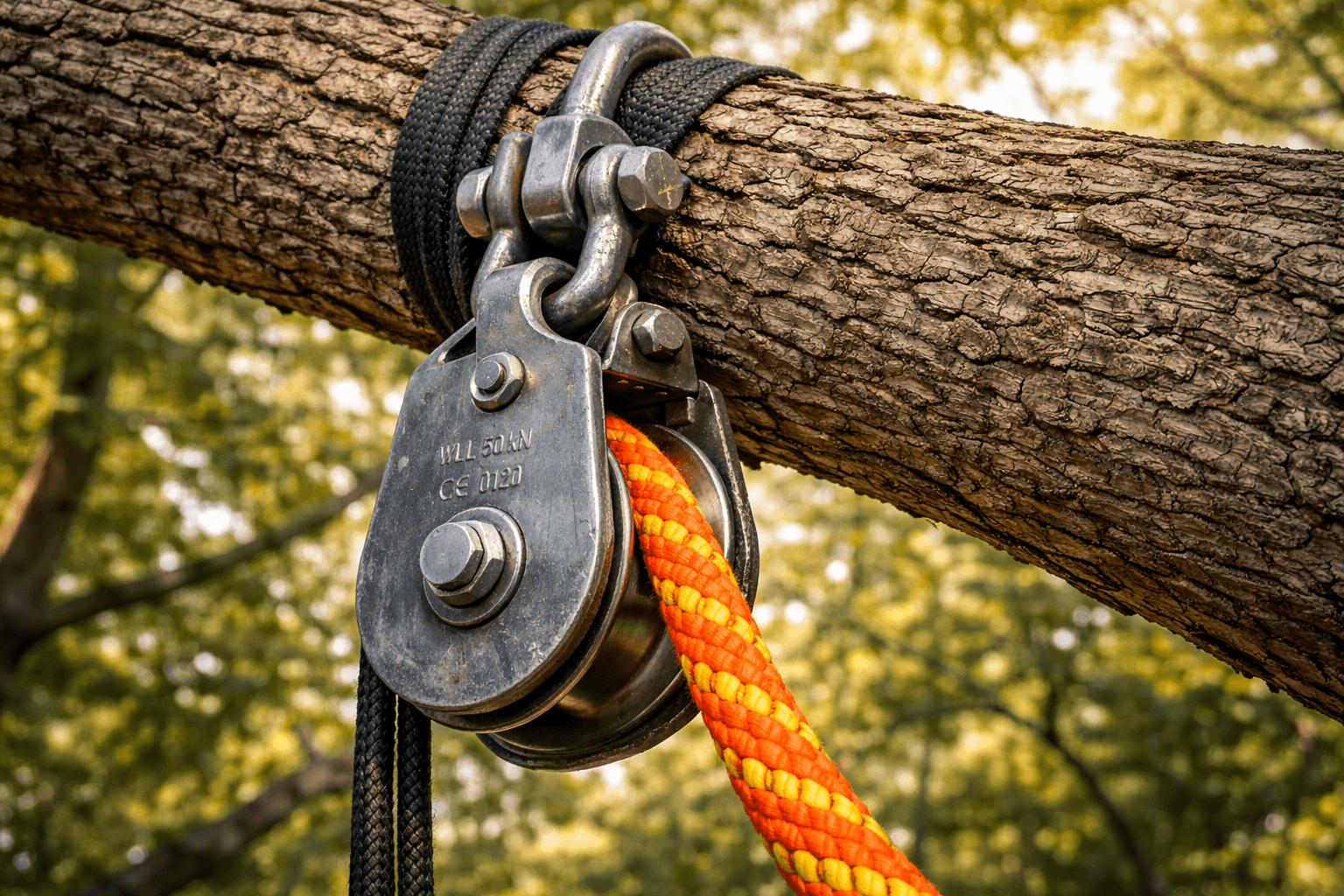
Tree Rigging Physics is the invisible force that either makes you look like a hero or turns your gear into shrapnel. When you’re dismantling a 10-ton oak over a glass roof, you don’t guess. You calculate.
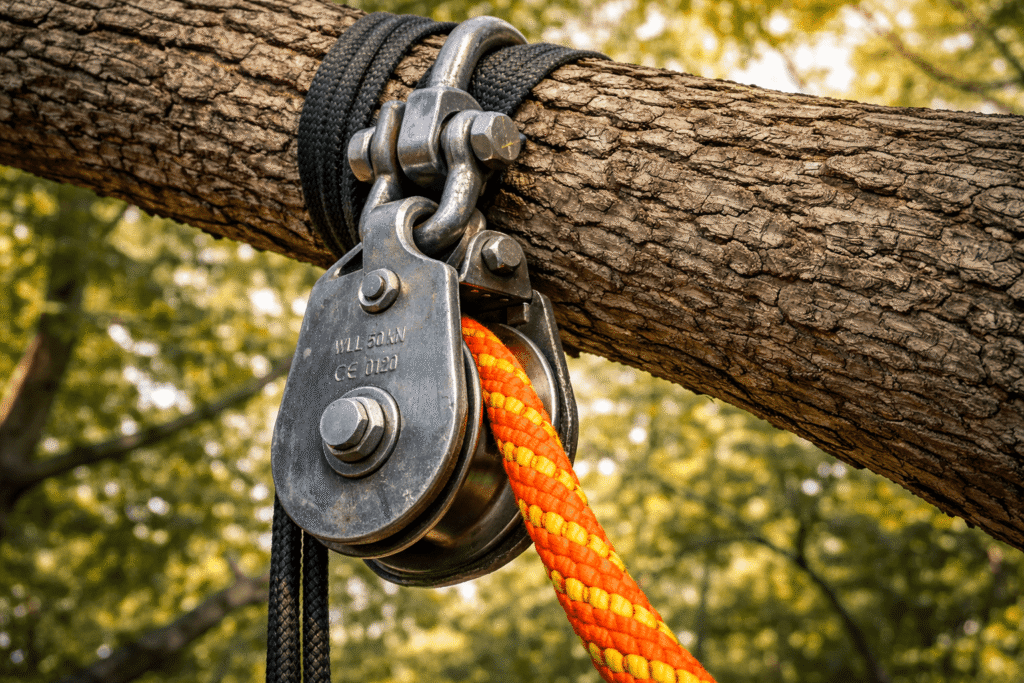
In my 15 years of experience, I’ve seen that most accidents happen because a climber trusted a “strong” rope without understanding the dynamic load multiplying behind it. This article is a deep dive into the mechanical advantage, shock loading, and ANSI Z133 standards that every professional must master to stay alive in the canopy.
Table of Contents
1. The Violent Truth of Shock Loading
The biggest killer in rigging isn’t the weight of the wood; it’s the distance it falls before the rope catches it. This is what we call “Shock Loading.”
- Static vs. Dynamic: A 500-lb limb sitting on a trailer is static. That same 500-lb limb falling 6 feet into a rigging block can easily generate 5,000 lbs of dynamic force.
- The Cycle to Failure: Every time you shock-load a rope, you’re eating into its life. Even if it doesn’t snap today, the internal fibers are melting.
- ANSI Z133 Protocol: Industry standards require a safety factor of 5:1 or even 10:1 for rigging lines. If you don’t know your rope’s WLL (Working Load Limit), you shouldn’t be making the cut.
2. Friction Management: Your Best Friend or Worst Enemy
In Tree Rigging Physics, friction is how we control chaos. Without it, the ground crew would be ripped into the air the moment a limb drops.
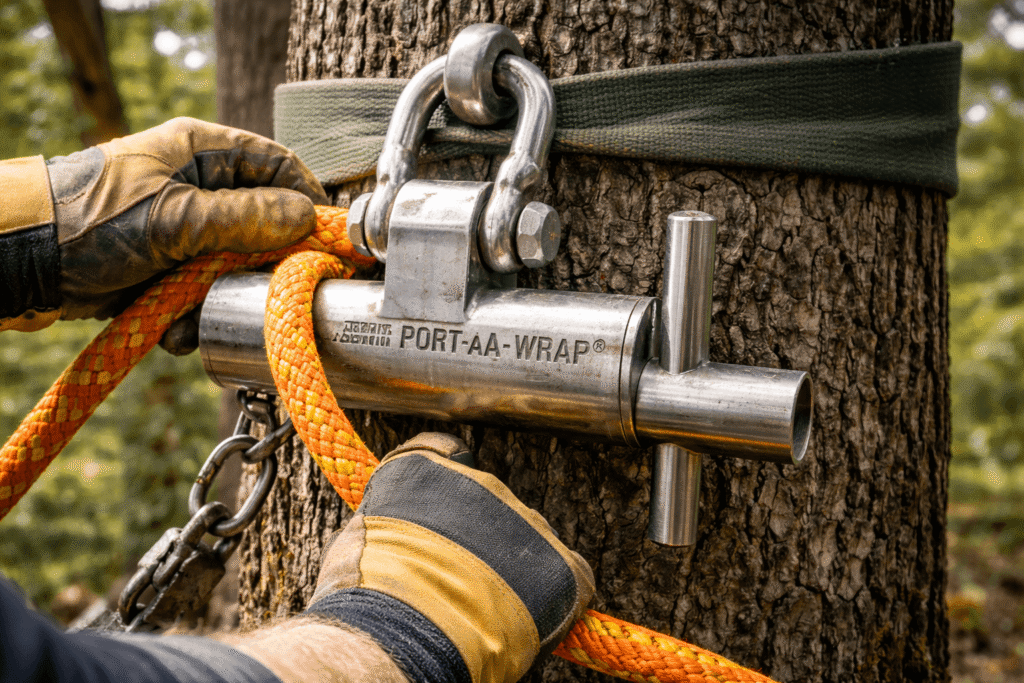
- The Port-a-Wrap: This device is a game-changer for ground crews. By wrapping the bull rope around the steel bollard, you use friction to dissipate the energy of a falling limb.
- Friction Fallacies: Too many wraps can be just as dangerous as too few. If the rope can’t “run” slightly, all that energy goes straight back into the anchor point in the tree, risking a catastrophic spar failure.
- Heat and Glazing: High-speed friction creates heat. If your rope looks shiny or feels stiff, it’s “glazed.” That means the physics won—and your rope is now a liability.
3. Mechanical Advantage: Moving Mountains with Pulleys
Sometimes you’re not just lowering wood; you’re pulling it away from a house or lifting it over a fence. This is where Mechanical Advantage (MA) systems like the 3:1 or 5:1 come in.
- MA Systems: By using pulleys and “Z-rigs,” you can multiply the force your ground crew exerts. A single person can pull with the strength of three.
- Rigging Blocks: Unlike standard hardware store pulleys, arborist rigging blocks are designed to handle the side-loading and impact of tree work.
- Vector Forces: Understanding the angle of your rope is critical. A rope diverted at a sharp 180-degree angle doubles the load on the anchor point. If that anchor is a dead limb, you’re asking for trouble.
4. Directional Felling and Rigging Synergy
Your rigging is only as safe as your notch is accurate. In my recent technical tree work videos, you can see the synergy between a clean notch and a tensioned rigging line.
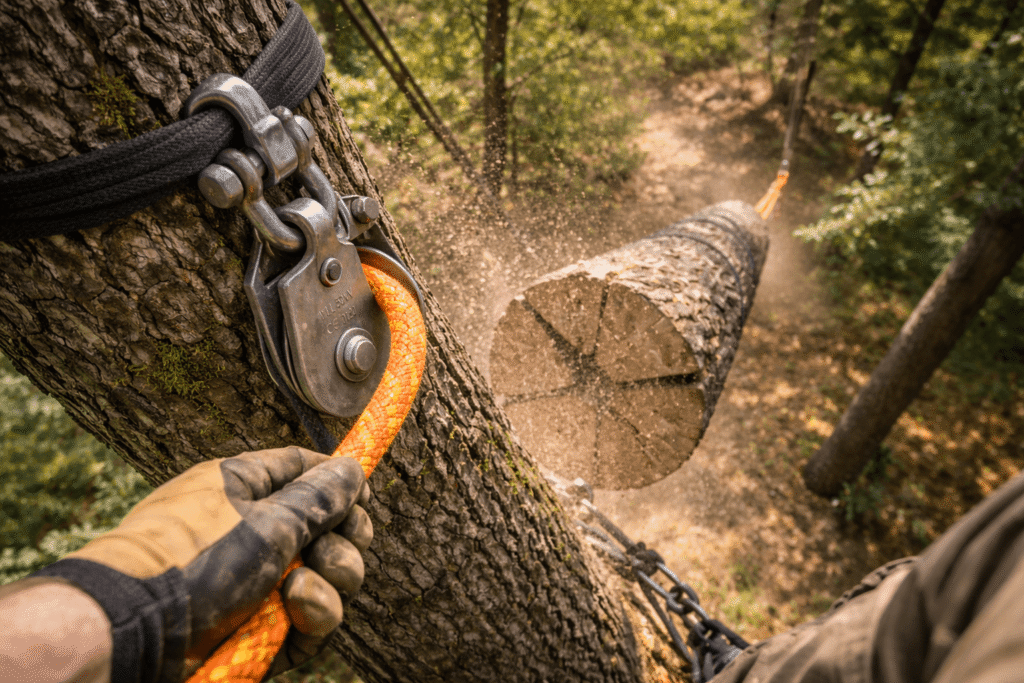
- The Precision Notch: A wide, clean notch allows the limb to pivot safely before the rigging line takes the full weight.
- Hinge Wood Integrity: The hinge is your steering wheel. If you “cut the back” and bypass your hinge while rigging, the physics becomes unpredictable, and the limb could swing anywhere.
- The “Clear” Call: Professional rigging requires a synchronized team. The climber makes the cut, but the ground crew “catches” the physics.
5. OSHA and ISA Safety Compliance
We don’t follow ANSI Z133 and OSHA standards just to avoid fines; we follow them to go home at night.
- Gear Retiring: OSHA 1910.266 states you must inspect gear before every shift. If a block has a nick or a carabiner was dropped on concrete, retire it.
- Double Tie-In: Even when focused on complex rigging, the climber must remain tied in at two points when the saw is running.
- Training: Physics doesn’t care about your ego. Continuous training in rigging physics is the hallmark of a true professional.